Why Standard RFID Fails in High-Temperature Environments
Conventional passive UHF RFID tags use PET or PVC substrates and aluminum or copper antennas — materials that degrade rapidly above 85°C. In autoclave sterilization (typically 121–134°C at 15–30 psi for 15–60 minutes) or industrial paint-curing ovens (180–250°C for 20–90 minutes), standard tags delaminate, lose antenna integrity, or suffer irreversible IC damage. This leads to catastrophic read failures during critical asset verification, compromising traceability, compliance, and process efficiency.
Engineering Solutions for High Temp RFID Manufacturing
Reliable high temp RFID manufacturing requires coordinated innovation across three layers: substrate, antenna, and IC encapsulation. RFIDHY’s certified high-temperature UHF RFID tags — such as the RFID-in-Manufacturing series — utilize:
- Ceramic or fused quartz substrates: Withstand continuous exposure up to 300°C and thermal shock cycling;
- High-melting-point metal antennas (e.g., platinum, nickel-chromium alloys): Maintain conductivity and bond integrity;
- Hermetically sealed IC packages: Impinj Monza R6-P or NXP UCODE DNA chips embedded in thermally stable epoxy or glass frit.
Performance Validation Standards
True high temp RFID manufacturing adheres to ISO 14971 (risk management), ASTM F2621 (thermal cycling test methods), and EN 285 (autoclave validation). RFIDHY tags undergo 50+ autoclave cycles (134°C, 3 bar, 5 min dwell) and 100+ paint-cure cycles (220°C, 45 min) with zero read loss — verified per RFID-in-Manufacturing application benchmarks.
Key Application Scenarios
| Application | Temp Range | Cycle Duration | RFIDHY Product Family |
|---|---|---|---|
| Medical instrument sterilization | 121–134°C | 15–60 min | Medical RFID Tags |
| Automotive component painting | 180–250°C | 20–90 min | Anti-Metal High-Temp RFID Tags |
| Aerospace composite curing | 150–200°C | 2–8 hrs | Laundry-Grade High-Temp Tags |
Integration Considerations for Smart Manufacturing Lines
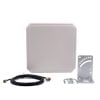
Deploying high temp RFID manufacturing systems requires more than tag selection. Antenna placement must avoid thermal shadow zones near oven walls or fixtures. Fixed readers like the HY-RU6508 8-port fixed reader support zone-based scanning at conveyor exits — enabling real-time verification before and after thermal processing. Integration with MES (Manufacturing Execution Systems) ensures serialized data flows directly into quality records and FDA 21 CFR Part 11-compliant audit trails.
FAQs
What is the maximum continuous operating temperature for RFIDHY’s high-temp UHF RFID tags?
RFIDHY’s ceramic-encapsulated UHF RFID tags maintain full read/write functionality at continuous temperatures up to 250°C. Certain models — including those used in aerospace tooling — are validated for intermittent exposure up to 300°C, as documented in our RFID Tag Finder technical datasheets.
Can these tags be reused across multiple autoclave cycles?
Yes. All RFIDHY high-temp RFID tags designed for medical sterilization undergo accelerated life testing of ≥50 autoclave cycles (134°C, 3 bar, 5 min) with zero functional degradation. Reusability is confirmed per ISO 17664 cleaning and disinfection validation protocols.
Do you offer custom encoding or serialization for batch traceability?
Yes. RFIDHY supports EPC Gen2v2 encoding, TID locking, and bulk serialization with unique EPC URIs aligned to GS1 standards. Custom encoding is available for integration with SAP, Oracle, or proprietary MES platforms — contact our engineering team via the Contact page.
Ready to Implement Reliable High-Temp RFID Tracking?
Whether you’re validating autoclave traceability for ISO 13485 compliance or optimizing paint-line throughput with real-time asset visibility, RFIDHY provides purpose-engineered high temp RFID manufacturing solutions — backed by technical documentation, sample kits, and application engineering support.
Leave your contact detail now to get the latest price!