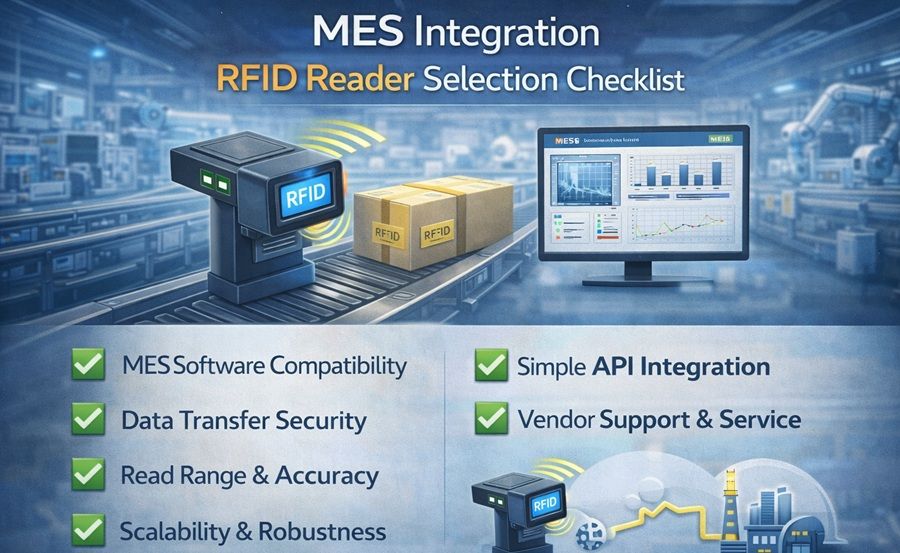
When deeply integrating RFID systems into Manufacturing Execution Systems (MES), especially in the demanding semiconductor and precision electronics industries, the communication method between the reader, equipment, and upper-level systems is crucial for success. Choosing an industrial reader that natively supports the SECS/GEM protocol is the most reliable path to achieving equipment automation, ensuring real-time data flow, and simplifying MES integration.
Why is the SECS/GEM protocol the gold standard for MES integration?
SECS/GEM is a globally recognized protocol for communication between equipment and host systems (such as MES) in the semiconductor and equipment manufacturing industries. Choosing an industrial reader that natively supports this protocol means:
- Plug-and-play integration: The reader can be directly managed by the MES or EAP (Equipment Automation Program) as a standard “device,” eliminating the need for complex intermediate conversion layers.
- Highly reliable communication: HSMS (SECS Message Services) transmission based on TCP/IP ensures stable and reliable message delivery in industrial network environments.
- Standardized data model: Read/write events (such as tag reading, antenna status) can be packaged into standard SECS-II messages (such as S6F11 event reports), which can be seamlessly parsed by the MES, greatly simplifying communication protocol adaptation.
Core Selection Considerations: Beyond the Protocol Itself
In addition to protocol support, choosing the right MES integration hardware also requires evaluating:
- RF performance and scene matching: In scenarios such as metal-enclosed load ports or high-speed moving AGVs, the reader needs excellent anti-collision algorithms and fast filtering capabilities.
- Industrial environment durability: The reader should have an IP67 or higher protection rating to adapt to workshop environments that may have dust, vibration, or temperature and humidity fluctuations.
- Integration and customization services: The protocol is the bridge, but transforming reader data into precise MES events (such as “Tray X has arrived at workstation Y, start operation”) requires a deep understanding of the process.
This is precisely where the value of professional suppliers like RFIDHY lies – they not only provide hardware integration solutions but also offer complete customized turnkey services of “reader + protocol gateway + data logic processing” based on their understanding of SECS/GEM and customer processes.
Q&A
1.If my MES doesn’t support SECS/GEM, does that mean I can’t use these readers?
Not necessarily. Readers that support SECS/GEM usually also support more general interfaces (such as MQTT, RESTful API, OPC UA). You can use an edge computing gateway or middleware to first aggregate the reader data via MQTT, and then the gateway converts it into a format that the MES can accept (such as database writing or Web Service calls). This increases flexibility but may introduce additional latency and complexity.
2.How to test and verify that the communication between the reader and MES via SECS/GEM is working correctly?
The standard approach is in two steps:
1) Protocol compliance testing: Use testing tools such as SECS Gemulator to simulate the MES and the reader exchanging standard messages, verifying basic connectivity and message compliance.
2) Business scenario testing: In a real or simulated production line, trigger actual tag reading events to verify whether the MES can correctly receive and parse the expected work order, material, and event information.
3.Compared to ordinary commercial readers, where are the main cost increases when choosing this type of industrial reader?
The main cost increases are reflected in:
1) The industrial-grade design and components of the hardware itself (wider temperature range, higher interference resistance);
2) The licensing and development of the software protocol stack (implementing SECS/GEM functionality);
3) Professional integration and verification services.
However, this investment translates into extremely high system reliability, low maintenance costs, and seamless integration with the automation system. From the perspective of total cost of ownership (TCO) and risk mitigation, the value is significant.
Conclusion
When choosing a suitable RFID reader for an MES system in an industrial environment requiring automation, it is wise to prioritize industrial readers that support or can be easily adapted to the SECS/GEM protocol. This ensures stable and standard communication protocol adaptation between the data acquisition layer and the execution layer.
When selecting specific hardware, factors such as radio frequency performance and environmental resistance should be considered comprehensively. It is recommended to prioritize solution partners, such as RFIDHY, that can provide comprehensive customized support ranging from hardware configuration and protocol adaptation to on-site debugging, ensuring the efficient and robust implementation of the entire MES integration project.
Leave your contact detail now to get the latest price!