Faced with increasingly stringent customer audits, regulatory requirements (such as ISO 9001, IATF 16949), and the continuous pursuit of yield improvement, traditional semiconductor manufacturing execution systems (MES) that rely on manual recording and barcodes are proving inadequate. A strategic MES upgrade, through the introduction of UHF RFID technology, is a key path to building a full lifecycle traceability and process closed-loop control system, achieving a digital transformation.
Traditional MES Traceability Breakpoints and the Value of RFID Closed-Loop Systems
In semiconductor manufacturing, a FOUP (Front Opening Unified Pod) may go through hundreds of processes. Traditional MES traceability breakpoints often occur in:
- Carrier movement relying on manual scanning, which is prone to errors and omissions under the high-speed operation of AMHS (Automated Material Handling System).
- Process equipment parameters (such as etching depth, film thickness) are difficult to automatically and accurately associate with specific Lot IDs and Wafer IDs.
- Work-in-progress (WIP) location is not transparent, and the time spent searching for goods accounts for 5-10% of the production cycle on average.
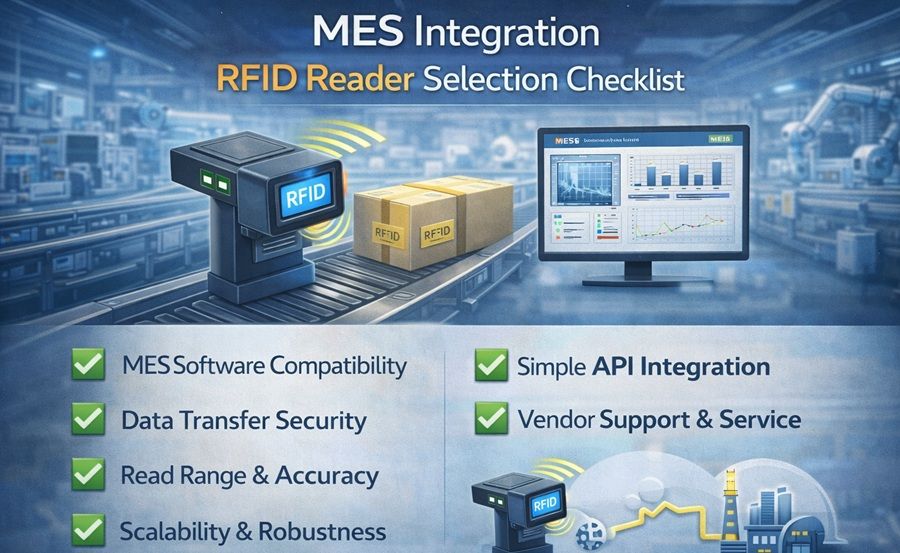
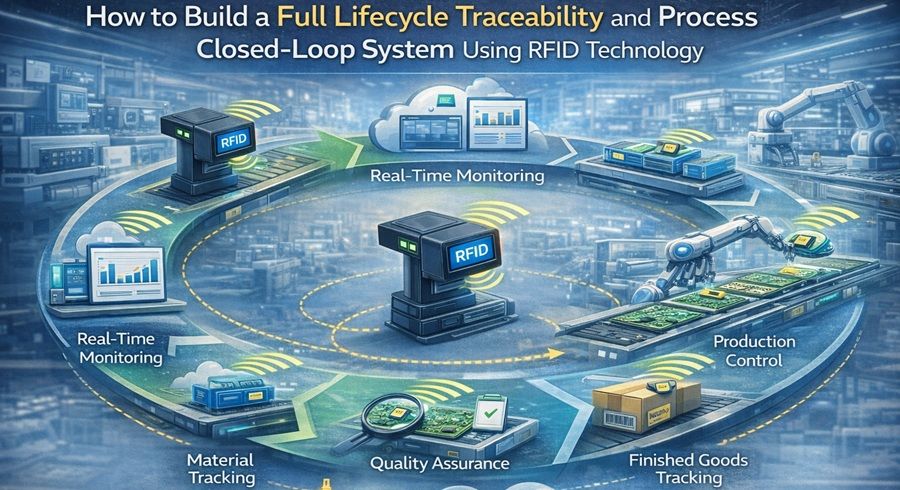
After integrating RFID, each carrier is given an unalterable digital identity. By deploying fixed readers at key nodes, the system can automatically and in real time capture carrier movement events and automatically associate them with process data reported by the equipment, forming a complete process closed-loop data chain.
Four-Step Framework for Building a Full Lifecycle Traceability Closed-Loop System
- Carrier and Material Unit Identification: Bind each FOUP and Reticle with high-temperature and chemical-resistant industrial RFID tags (such as encapsulated tags based on Impinj Monza R6 chips) as data carriers throughout the entire process.
- Automated Data Collection at Key Nodes: Deploy readers at equipment load ports, storage racks, and intersections to automatically record the “when, where, and what state” of the carriers.
- Seamless Process Data Binding: Through EAP (Equipment Automation Program), the equipment’s Recipe ID and measurement data (from CD-SEM, film thickness gauge) are bound in real-time with the currently read RFID tag ID and uploaded to the MES, enabling process parameter traceability.
- Panoramic Data Integration and Closed-Loop Decision Making: The upgraded MES integrates data from people, machines, materials, and methods across the entire process. When the final test yield of a batch of products is abnormal, it can instantly trace back to the specific equipment, parameters, and operation records at each station, enabling root cause analysis (RCA), and feeding improvement measures back into production standards in a closed loop.
Comparison of Core Benefits Brought by RFID Upgrade
| Dimension | Before Upgrade (Traditional MES + Barcode) | After Upgrade (MES + RFID) |
| Data Accuracy | Manual entry, error rate approximately 0.5%-1% | Automatic collection, accuracy >99.9% |
| Traceability Efficiency | Tracing a batch of products takes several hours | Second-level reverse traceability |
| WIP Visibility | Delayed updates, vague location | Real-time, precise positioning |
| Compliance Management | Preparing audit reports is time-consuming and risky | Automatically generates electronic traceability reports, easily meeting FDA 21 CFR Part 11 and other audit requirements |
Key to Successful Upgrade: Professional Customization and Integration
The semiconductor environment is extremely complex, and generic RFID solutions are bound to fail. Success depends on a deep understanding of the process and customization capabilities. For example, when serving clients, RFIDHY will:
- Customize corrosion-resistant tag packaging for carriers in wet cleaning and CMP processes.
- Conduct radio frequency site surveys in equipment areas full of metal interference, and design customized antenna solutions to ensure stable reading.
- Develop edge computing logic to filter massive read/write events, reporting only critical, business-logic-containing events (such as “FOUP A has completed ion implantation”) to the MES, avoiding system overload.
Q&A
1.Will upgrading the MES with RFID interfere with sensitive measurement and testing equipment in the workshop?
Not under professional deployment. A rigorous EMC (electromagnetic compatibility) assessment must be conducted before implementation. By selecting compliant equipment within the designated operating frequency band (e.g., 865-868MHz), precisely controlling the reader’s transmission power, and conducting on-site spectrum testing, the coexistence of the RFID system with precision equipment can be ensured. Professional service providers like RFIDHY implement this as a standard procedure.
2.How to evaluate the return on investment (ROI) of the upgrade project?
ROI primarily comes from:
1) Increased efficiency: Reducing manual labor costs for vehicle searching and data entry (approximately 30-50%);
2) Quality cost savings: Shortening response time to quality issues through rapid traceability, reducing scrap losses;
3) Increased capacity: Improving equipment utilization (by reducing WIP backlog and waiting time);
4) Compliance value: Avoiding business risks due to audit non-compliance. The typical project payback period is 18-24 months.
3.We already have an old MES and some barcode systems, how can we achieve a smooth transition?
A phased, incremental upgrade strategy is recommended. For example, start with a pilot program in the later stages of production (such as testing and packaging) or on a newly built production line, running a dual-track system of RFID and barcodes to verify data consistency. Simultaneously, choose an RFID middleware platform that provides open APIs (such as RESTful, MQTT) and rich drivers (such as OPC UA) to ensure flexible integration with the existing MES and a smooth migration.
Conclusion
For semiconductor manufacturing, integrating RFID technology into MES upgrades is far more than simply replacing data collection tools; it’s a strategic investment in building core competitiveness. It provides a reliable technical foundation for full lifecycle traceability from wafer to chip, transforming compliance management from a burden into an advantage, and ultimately driving continuous improvement in yield and operational efficiency through process closed-loop control.
Collaborating with partners with extensive semiconductor industry experience and deep customization capabilities (such as RFIDHY) is key to ensuring the success of this upgrade and maximizing investment value.
Leave your contact detail now to get the latest price!