The Physics Behind the Trade-off
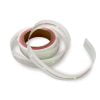
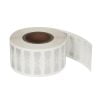
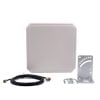
RFID tag size directly influences antenna geometry, which governs electromagnetic coupling efficiency with readers. Larger antennas support longer read ranges by capturing more energy from incident RF fields — but introduce constraints in space-constrained assets like surgical instruments or small electronic components. Smaller tags sacrifice range for discreet integration, demanding higher-sensitivity RFID chips and optimized reader configuration.
Key Performance Variables
Three interdependent factors determine effective read range:
- Antenna area and tuning: Larger surface area enables broader frequency bandwidth and improved impedance matching.
- Chip sensitivity: Modern UHF RFID chips (e.g., Impinj Monza, NXP UCODE) achieve -18 dBm sensitivity, enabling operation with smaller antennas.
- Environmental interference: Metal, liquids, and dense materials attenuate signals — requiring specialized designs like anti-metal RFID tags that maintain performance despite size limitations.
Practical Sizing Guidelines by Use Case
| Application | Typical Tag Size | Max Reliable Read Range | Recommended Product Category |
|---|---|---|---|
| Pallet & Container Tracking | 102 × 152 mm (4″ × 6″) | 12+ meters | Warehouse RFID solutions |
| Reusable Transport Items (RTIs) | 50 × 50 mm | 6–8 meters | MRO & asset tracking |
| Surgical Instrument Tracking | 12 × 25 mm | 0.3–0.8 meters | Healthcare RFID tags |
rfid产品推荐
For enterprise deployments requiring precision sizing without compromising reliability, RFIDHY offers engineered solutions aligned with ISO/IEC 18000-63 standards:
- Industrial anti-metal RFID tags — optimized for metal-rich environments with compact 30 × 30 mm form factor and 4-meter read range.
- Laundry RFID tags — autoclavable, wash-resistant 25 × 45 mm inlays for textile asset tracking.
- Access control RFID cards — ISO-compliant 85.6 × 53.98 mm smart cards with MIFARE DESFire EV3 chips for secure credentialing.
FAQ
Does doubling tag size double read range?
No. Read range scales approximately with the square root of antenna area due to electromagnetic field dynamics — not linearly. Doubling physical dimensions increases area fourfold, yielding only marginal range gains beyond optimal tuning thresholds.
Can a small RFID tag achieve long range in ideal conditions?
Yes — with high-gain reader antennas, elevated power output (within regulatory limits), and line-of-sight deployment. However, enterprise environments demand consistent performance across variable orientations and materials, favoring balanced size-range profiles.
Are NFC tags subject to the same size-range trade-off?
Yes, though more acutely: NFC operates at 13.56 MHz with inherently shorter wavelengths and stricter coupling requirements. A 25 mm² NFC inlay typically achieves ≤10 cm range — making NFC chip selection and antenna layout even more critical.
Optimize Your RFID Deployment
Need help selecting the right RFID tag size and chip configuration for your specific environment? Our engineering team provides free technical consultation and custom sample kits — backed by ISO-certified manufacturing and global logistics support.
Leave your contact detail now to get the latest price!