Why Hospital RFID Asset Tracking Matters
Hospital equipment downtime directly impacts patient throughput, staff efficiency, and operational cost. Studies show that up to 20% of mobile medical assets—including wheelchairs, infusion pumps, and adjustable beds—are routinely misplaced or underutilized. RFID-based hospital RFID asset tracking delivers real-time location visibility, automated check-in/out workflows, and usage analytics without requiring manual scanning or barcode line-of-sight.
Technical Requirements for Medical Equipment Tracking
Unlike retail or warehouse environments, healthcare facilities demand specialized RFID solutions due to metal-rich surfaces (e.g., stainless steel beds), proximity to liquids (IV bags), and strict hygiene protocols. Successful deployments rely on three core components:
- On-metal UHF RFID tags engineered for consistent read performance on conductive surfaces;
- Fixed and handheld readers with configurable power output and filtering for high-density environments;
- Integration-ready middleware that syncs with existing CMMS (Computerized Maintenance Management Systems) and EHR platforms.
Tag Selection for Wheelchairs, Pumps, and Beds
Standard passive UHF RFID tags fail on metal. Instead, hospitals use purpose-built anti-metal RFID tags with ferrite shielding and optimized antenna geometry. These are typically mounted inside frame cavities or behind non-reflective panels to preserve aesthetics and prevent tampering. For infusion pumps—which often contain batteries and dense electronics—tags must also withstand repeated disinfection cycles. RFIDHY’s healthcare RFID product category includes IP68-rated, chemical-resistant tags validated for clinical environments.
Reader Infrastructure and Coverage Planning
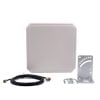
Fixed readers installed at department entrances, elevator lobbies, and storage corridors create virtual checkpoints. Handheld readers supplement coverage during audits or incident investigations. The HY-RU6508 fixed reader with 8 antenna ports enables wide-area monitoring across multi-floor wings without signal overlap interference. Reader placement follows RF propagation modeling—not just proximity—to avoid blind zones near MRI suites or shielded walls.
Real-World Performance Benchmarks
Deployments across tier-2 hospitals in Asia and Europe report the following average outcomes within 90 days of go-live:
| Metric | Pre-RFID | Post-RFID |
|---|---|---|
| Average time to locate a wheelchair | 12.4 minutes | <1.3 minutes |
| Infusion pump utilization rate | 58% | 79% |
| Bed turnover cycle time | 47 minutes | 32 minutes |
Integration with Clinical Workflows
Effective hospital RFID asset tracking does not operate in isolation. It integrates with nurse call systems to alert staff when a tagged wheelchair enters a restricted zone, triggers maintenance tickets in CMMS upon exceeding usage thresholds, and feeds occupancy data into bed management dashboards. All integration is achieved via standard REST APIs and HL7/FHIR-compatible middleware—no proprietary gateways required. RFIDHY’s healthcare RFID solutions are designed for interoperability with leading EHR platforms including Epic and Cerner.
Frequently Asked Questions
Can RFID tags withstand hospital-grade disinfectants?
Yes. RFIDHY’s medical-grade UHF RFID tags are rated IP68 and tested against common disinfectants including 70% isopropyl alcohol, hydrogen peroxide vapor, and sodium hypochlorite solutions. Full validation reports are available upon request.
Do RFID tags interfere with medical devices like pacemakers or MRI machines?
No. Passive UHF RFID tags emit no RF energy—they only reflect signals from readers operating well below FCC/IEC safety limits. Readers deployed in clinical areas comply with IEC 60601-1-2 for electromagnetic compatibility. Independent testing confirms zero interference with Class III medical devices.
Are there RFID wristbands compatible with this tracking system?
Yes. For patient-facing applications such as admission-linked equipment assignment, RFID-enabled wristbands from wristbandhy.com’s medical wristband collection support dual-frequency (HF + UHF) operation and integrate seamlessly with the same backend infrastructure used for asset tracking.
Ready to Optimize Your Hospital’s Equipment Utilization?
RFIDHY offers pre-validated RFID solutions for healthcare asset tracking—including anti-metal tags, fixed and handheld readers, and integration support tailored to hospital IT and biomedical engineering teams. Request a technical consultation or schedule a live demo of our healthcare RFID platform.
Leave your contact detail now to get the latest price!