
Summary: Explore the materials science behind high temperature RFID tags engineered to withstand 300°C. Ideal for semiconductor, automotive & aerospace applications.
Introduction: Why 300°C Is a Critical Threshold
In industrial automation, semiconductor fabrication, and aerospace manufacturing, asset identification must persist through extreme thermal cycles. Standard passive UHF RFID tags typically fail above 85°C due to delamination, antenna deformation, or silicon die degradation. Yet processes like solder reflow (260–300°C), ceramic sintering, and turbine component testing demand reliable identification at sustained 300°C exposure. This capability isn’t incremental—it’s foundational to closed-loop MES integration and zero-defect traceability.
Core Material Systems Enabling 300°C Operation
Ceramic Substrates: Thermal Stability Meets Dielectric Consistency
Unlike FR-4 or PET-based carriers, high-temp RFID tags use alumina (Al₂O₃) or aluminum nitride (AlN) substrates. These ceramics exhibit near-zero coefficient of thermal expansion (CTE) mismatch with silicon ICs, minimizing mechanical stress during thermal cycling. Alumina offers excellent dielectric stability up to 1700°C, while maintaining consistent permittivity (εᵣ ≈ 9.8) across -55°C to +300°C—ensuring predictable antenna impedance and read range stability.
Polyimide Encapsulation: Flexible Protection Without Compromise
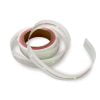
RFIDHY’s ultra-high-temp tags utilize two-layer polyimide (PI) films—Kapton® HN-grade—with glass transition temperatures exceeding 410°C. Unlike epoxy resins (Tg ~150°C), polyimide retains tensile strength (>100 MPa) and elongation (>30%) even after 100 hours at 300°C. Its inherent chemical resistance prevents hydrolysis in humid reflow environments, eliminating blistering—a common failure mode in moisture-sensitive packaging lines.
Metallization: Silver Palladium Alloy Traces
Copper traces oxidize rapidly above 200°C; aluminum diffuses into silicon at elevated temperatures. RFIDHY employs sputtered silver-palladium (Ag-Pd, 92/8 wt%) alloy antennas. This composition delivers resistivity <2.5 μΩ·cm, oxidation resistance up to 350°C, and interfacial adhesion strength >15 MPa on ceramic substrates—validated per ASTM D3359 cross-hatch testing.
Real-World Validation: Beyond Lab Specifications
Compliance with industry standards is non-negotiable. RFIDHY high temperature RFID tags undergo:
- MIL-STD-202G Method 108 (Thermal Shock: -55°C ↔ +300°C, 100 cycles)
- JEDEC JESD22-A104F (High Temp Operating Life at 300°C for 1,000 hours)
- IPC-2221B Section 8.2 (Surface Mount Reflow Profile Compatibility)
- ISO/IEC 18000-63 (UHF Air Interface Protocol Performance at Elevated Temperatures)
Each batch is traceable to material lot numbers and certified with full test reports—including S-parameter sweeps confirming VSWR < 2.0 across 860–960 MHz at 300°C.
Application Spotlight: Where 300°C RFID Adds Value
Semiconductor Wafer Carriers
FOUPs (Front Opening Unified Pods) and SMIF pods undergo repeated cleaning, baking, and plasma etching cycles. Embedding ceramic-based RFID tags directly into carrier frames enables real-time location tracking and automated process validation—reducing human error in tool dispatch sequences. Learn more in our guide on ultra-small RFID advantages in wafer manufacturing.
Automotive Powertrain Components
Engine blocks, turbochargers, and exhaust manifolds require post-production serialization traceability. Tags embedded into cast aluminum housings survive both casting (up to 700°C pour temp) and subsequent heat treatment—enabling end-to-end digital twin linkage from foundry to OEM assembly line.
Aerospace Composite Curing
Carbon-fiber autoclaves operate at 180–300°C under 100+ psi pressure. RFID tags bonded to composite tooling fixtures provide unambiguous mold ID verification before each layup cycle—preventing costly misalignment and scrap.
Design Considerations for Integration Engineers
Deploying high temperature RFID tags requires attention beyond datasheet specs:
- Antenna Coupling: Metal proximity alters resonant frequency—use simulation tools (e.g., CST Studio Suite) to model tag-on-metal behavior at target temperature.
- Reader Selection: Prioritize readers with adjustable dwell time and adaptive power control to maintain link budget amid thermal drift.
- Mounting Methodology: Avoid epoxy-only bonding; combine high-temp ceramic adhesive (e.g., Emerson & Cuming ECCOBOND™ 430) with mechanical retention features.
For implementation support, explore our RFID Tag Finder tool or review our USE CASE library for validated deployments.
Frequently Asked Questions
- What is the maximum continuous operating temperature for RFIDHY’s high temperature RFID tags?
- Our certified ceramic-substrate tags sustain continuous operation at 300°C for ≥1,000 hours, with peak short-term tolerance up to 350°C for ≤5 minutes—validated per JEDEC JESD22-A104F.
- Can these tags be soldered directly onto PCBs?
- Yes. Designed for compatibility with lead-free reflow profiles (peak 260°C, 60 sec), they withstand standard SMT processes without performance degradation.
- Do high temperature RFID tags work on metal surfaces?
- They are optimized for metal-mount applications. Our Ag-Pd antenna design and ceramic substrate minimize detuning—read range remains stable within ±15% when mounted directly to stainless steel or aluminum.
- Are these tags compliant with global UHF regulations?
- Yes. Fully certified to ETSI EN 302 208, FCC Part 15C, and MIC Article 2 paragraph 1 (Japan), including radiated emission limits at elevated temperatures.
- What read range can be expected at 300°C?
- In open-air conditions, typical read range is 3–5 meters using a 4W ERP fixed reader and circularly polarized antenna. Range may decrease by ≤20% in dense metal-rich environments due to thermal-induced impedance shifts—compensated via reader sensitivity tuning.
Ready to Integrate High-Temperature RFID Into Your Process?
RFIDHY provides application engineering support, custom tag prototyping, and full environmental validation services—from thermal cycling to chemical exposure testing.
Request Technical Consultation or explore our TAILORED solutions for mission-critical deployments.
Leave your contact detail now to get the latest price!