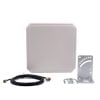
Introduction: The Critical Need for Reliable Gas Cylinder Tracking
Gas cylinder management in industrial, healthcare, and logistics environments demands precision, safety, and full traceability. Manual or barcode-based systems often fall short under high-volume, multi-site, or harsh-condition operations. A robust gas cylinder tracking system must support real-time location awareness, automated audit trails, tamper-evident logging, and integration with ERP or EAM platforms. This article provides a professional, data-grounded comparison of RFID and barcode solutions — focusing strictly on measurable ROI factors relevant to enterprise decision-makers.
Core Operational Differences
Barcodes require line-of-sight scanning, manual orientation, and clean, undamaged surfaces. In contrast, UHF RFID tags — such as those in the UHF RFID tags portfolio at rfidhy.com — enable bulk reading (up to 100+ cylinders simultaneously), non-line-of-sight operation, and resilience to dust, moisture, and minor surface wear. These attributes directly reduce labor time per scan cycle and eliminate misreads caused by label damage or misalignment.
Quantifying Total Cost of Ownership (TCO)
While barcode labels have lower upfront material costs, their lifecycle expenses accumulate rapidly through labor, reprints, scanner maintenance, and reconciliation efforts. RFID deployments incur higher initial hardware investment but deliver rapid payback via automation. For example, a mid-sized industrial gas distributor reported a 68% reduction in cylinder reconciliation labor hours after deploying RFID inventory management workflows using ruggedized UHF tags.
ROI Comparison Table
| Factor | Barcode System | RFID System |
|---|---|---|
| Avg. Scan Time per Cylinder | 8–12 seconds (manual alignment + scan) | 0.3–0.8 seconds (bulk read, no orientation) |
| Label Lifespan in Industrial Warehouse | 6–18 months (prone to abrasion, chemical exposure) | 5+ years (epoxy-encapsulated UHF tags, e.g., industrial-grade UHF RFID tags) |
| Inventory Accuracy Rate | 89–94% (post-reconciliation) | 99.2–99.8% (real-time, automated) |
Regulatory & Safety Implications
Regulatory frameworks such as OSHA 1910.101 and ISO 45001 emphasize traceability, inspection history, and pressure certification validity. RFID enables automatic association of cylinder-specific metadata — including hydrotest dates, fill records, and maintenance logs — to digital twin profiles. This eliminates manual logbook entry errors and supports instant audit readiness. Barcode systems require additional software layers and manual data entry to achieve comparable compliance coverage — increasing both risk and overhead.
Scalability and Integration Readiness
Modern gas cylinder tracking system architectures must integrate with MES, CMMS, and IoT platforms. RFID infrastructure — including readers, antennas, and middleware — is natively compatible with industrial protocols like MQTT, OPC UA, and SECS/GEM. Barcode systems rely heavily on proprietary mobile apps or custom API wrappers, limiting interoperability. For enterprises planning future expansions into predictive maintenance or AI-driven anomaly detection, RFID provides a foundational, future-proof layer — as demonstrated in recent embedded RFID deployments.
Frequently Asked Questions
- Can RFID tags withstand high-pressure cylinder environments? Yes — industrial UHF RFID tags designed for metal-mount applications (e.g., metal-mount UHF RFID tags) operate reliably under vibration, thermal cycling, and mechanical stress typical in gas handling facilities.
- Do I need new infrastructure to deploy RFID for cylinder tracking? Minimal infrastructure is required: fixed-mount readers at dock doors, handheld readers for yard audits, and durable RFID tags. Existing ERP systems integrate via standard REST APIs or middleware — no legacy replacement needed.
- Are RFID tags compatible with existing barcode scanners? No — RFID requires dedicated readers and antennas. However, hybrid solutions (e.g., dual-mode labels) are not recommended due to compromised performance and added complexity. Pure RFID delivers superior ROI in asset-intensive scenarios like gas cylinder logistics.
Ready to Evaluate RFID for Your Gas Cylinder Operations?
RFIDHY offers engineered gas cylinder tracking system solutions — from certified UHF RFID tags and industrial readers to turnkey integration support. Our technical team provides site assessments, ROI modeling, and pilot deployment guidance tailored to your operational scale and compliance requirements.
Contact our industrial solutions specialists today to request a customized evaluation package — including tag sample kits and a TCO benchmark report for your facility.
Leave your contact detail now to get the latest price!