The Dual Challenge: Why Liquid and Metal Degrade RFID Performance
RFID relies on electromagnetic coupling between reader antennas and tag inlays. Liquids — especially those with high water or salt content — absorb UHF signals, while conductive metals reflect and detune them. When both are present (e.g., tagged metal containers filled with coolant, lubricants, or beverages), standard passive UHF RFID tags often fail entirely. This is not a limitation of RFID technology per se, but rather a matter of intentional system engineering.
Physics-Informed Design Strategies
Successful operation in combined liquid-metal environments requires coordinated optimization across three layers:
- Tag Antenna Geometry: Meandered or folded dipole designs reduce sensitivity to nearby dielectrics and conductors. Ground-plane-isolated antennas minimize coupling loss when mounted directly on metal surfaces.
- Substrate & Encapsulation: Ceramic or high-temperature PPS substrates offer stable dielectric properties across temperature and humidity shifts. Hermetic sealing prevents moisture ingress that would further degrade performance.
- Reader Configuration: Adaptive power control, frequency hopping (ETSI-compliant), and polarization diversity improve link budget resilience against multipath and absorption.
Validated Hardware for Dual-Environment Applications
RFIDHY’s UHF RFID metal-mount tags are specifically engineered for attachment to conductive surfaces and maintain stable resonance even when immersed in non-conductive liquids (e.g., oils, ethanol, glycerin). For applications requiring simultaneous immersion and proximity to metal — such as tracking stainless-steel vials in biopharma cold chains — the RFID inventory management solutions platform integrates validated tag-reader pairs with calibrated firmware profiles.
Real-World Deployment Considerations
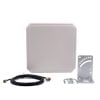
Environmental validation is non-negotiable. We recommend conducting on-site RF characterization using calibrated spectrum analyzers before full-scale rollout. Key variables include liquid depth, container wall thickness, fill level consistency, and ambient RF noise. In one verified deployment at an automotive Tier-1 supplier, RFIDHY’s asset tracking solution achieved >99.3% read accuracy on aluminum engine blocks partially submerged in synthetic transmission fluid — using custom-tuned 865–868 MHz tags and linear-polarized panel antennas mounted at 45° incidence.
Comparative Performance Summary
| Tag Type | Mounting Surface | Liquid Exposure | Avg. Read Range (m) |
|---|---|---|---|
| Standard UHF Inlay | Plastic | None | 7.2 |
| Metal-Mount Tag (Ceramic) | Aluminum | None | 3.8 |
| Dual-Environment Tag (PPS + Epoxy) | Stainless Steel | Submerged (oil) | 2.1 |
Frequently Asked Questions
Can standard RFID tags work through liquid and metal?
No. Standard passive UHF RFID tags experience severe detuning and absorption when placed near metal or within high-dielectric liquids. Dedicated dual-environment tags are required.
Do I need special readers to read tags through liquid and metal?
Not necessarily — but reader configuration matters. Industrial readers supporting adaptive power, polarization switching, and ETSI frequency agility (e.g., models listed on RFIDHY’s UHF RFID readers page) significantly improve reliability.
Are NFC tags suitable for this use case?
No. NFC operates at 13.56 MHz and has inherently shorter range and higher susceptibility to metallic interference. UHF RFID (860–960 MHz) offers superior penetration and is the only viable passive option for industrial-scale dual-environment tracking.
Ready to Deploy Reliable RFID in Complex Environments?
RFIDHY provides application-specific tag validation, on-site RF site surveys, and integration support for liquid-and-metal scenarios. Our engineering team works directly with your technical stakeholders to define test protocols, select optimal hardware, and verify performance before rollout.
Leave your contact detail now to get the latest price!