Why Standard RFID Antennas Fail on Metal Surfaces
When deployed directly on conductive surfaces like steel, aluminum, or stainless-steel enclosures, conventional RFID antennas suffer severe performance degradation. Metal reflects and absorbs electromagnetic waves, causing destructive interference, frequency detuning, and dramatic reduction in effective read range — often rendering standard UHF RFID tags unreadable. This challenge is especially critical in industrial asset tracking, automotive manufacturing, and smart infrastructure applications where metal is ubiquitous.
Core Design Strategies for On-Metal RFID Antennas
Successful on-metal RFID antenna design relies on three interdependent engineering approaches:
- Dielectric Spacing & Isolation: A precisely engineered air gap or low-permittivity dielectric layer between the antenna radiating element and the metal surface minimizes capacitive coupling and preserves resonant frequency stability.
- Ground-Plane Integration: Rather than fighting metal, advanced designs treat it as a controlled part of the antenna system — using the metal surface as an intentional ground plane to enhance gain and directivity in specific directions.
- Magnetic Field Coupling Optimization: For HF/NFC applications, loop-based antennas with high inductance and ferrite backing increase magnetic flux density near metal, enabling reliable short-range communication even on ferrous substrates.
Material Selection and Construction Rigor
Durability under thermal cycling, vibration, and chemical exposure is non-negotiable in industrial settings. High-performance on-metal antennas use reinforced polymer housings, corrosion-resistant metallization (e.g., silver ink or electroplated copper), and thermally stable substrates such as polyimide or ceramic-filled PTFE. These materials ensure mechanical integrity and consistent RF behavior across operating temperatures from −40°C to +105°C.
Performance Validation: Beyond Lab Bench Testing
Lab measurements alone are insufficient. Real-world validation requires testing across variable metal thicknesses (0.5 mm to 10 mm), surface finishes (powder-coated, galvanized, bare), and mounting configurations (bolted, adhesive-backed, embedded). At RFIDHY, every on-metal antenna undergoes ISO/IEC 18000-63-compliant field testing on representative industrial assets — including CNC machine frames, HVAC ductwork, and logistics pallets — ensuring repeatability in production environments.
Selecting the Right Antenna for Your Use Case
Application context dictates optimal antenna type:
| Use Case | Recommended Antenna Type | Key Feature |
|---|---|---|
| Metal Asset Tracking (Tools, Carts, Containers) | UHF On-Metal Patch Antenna | 360° omnidirectional coverage, IP68-rated housing |
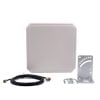
| Automated Gate Access Control | UHF Linearly Polarized Panel Antenna | High front-to-back ratio, 12 dBi gain |
| Medical Equipment Identification (Stainless Steel) | HF Ferrite-Backed Loop Antenna | <5 cm read range, EMI-resilient design |
For enterprise-grade deployment, consult our full portfolio of RFID antennas engineered specifically for demanding industrial conditions — including on-metal, high-temperature, and embedded configurations. Our asset tracking solutions integrate seamlessly with these antennas to deliver end-to-end visibility across metal-intensive operations.
Frequently Asked Questions
Can I use a standard RFID antenna on metal if I add extra spacing?
No. Simply increasing distance does not resolve fundamental impedance mismatch and radiation pattern distortion. Purpose-built on-metal antennas incorporate integrated ground-plane compensation and tuned matching networks that generic spacers cannot replicate.
What’s the difference between ‘on-metal’ and ‘near-metal’ RFID tags?
‘On-metal’ tags are designed for direct, permanent attachment to conductive surfaces without performance loss. ‘Near-metal’ tags require a minimum standoff distance (typically ≥5 mm) and are unsuitable for flush-mount applications where space or aesthetics constrain installation.
Do on-metal RFID antennas work with all UHF readers?
Yes — all RFIDHY on-metal antennas comply with EPCglobal Class 1 Gen 2 (ISO/IEC 18000-63) standards and are compatible with industry-standard UHF RFID readers. For integration support, explore our industrial RFID readers.
Ready to Deploy Reliable On-Metal RFID?
Whether you’re digitizing tool cribs, automating equipment check-in, or hardening supply chain traceability on metal assets, RFIDHY delivers rigorously tested, application-validated antenna solutions. Our engineering team provides free antenna selection guidance, site surveys, and interoperability testing — backed by ISO 9001-certified manufacturing.
Contact our RFID antenna specialists today to request technical documentation, sample units, or a customized deployment roadmap.
Leave your contact detail now to get the latest price!