Introduction: Precise Management is a Must for Healthcare Operations
In the medical field, precise management of surgical instruments, implants, and high-value medical consumables directly impacts patient safety, operating costs, and regulatory compliance. Traditional manual record-keeping or barcode management is inefficient and prone to errors. The emergence of ultra-small, sterilizable ultra-micro RFID tags offers a revolutionary solution to this challenge, reshaping the paradigm of medical equipment tracking in leading healthcare institutions worldwide.
Technological Core: How do Ultra-Micro RFID Tags Achieve “Millimeter-Level” Management?
Ultra-micro RFID tags are based on UHF RAIN RFID technology (compliant with the GS1 EPC Gen2 standard), with the following core advantages:
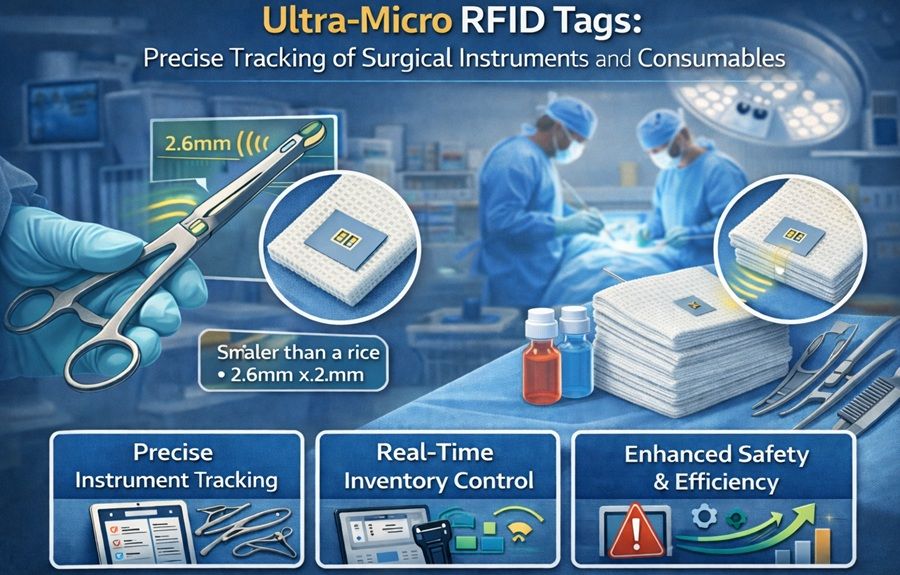
- Extreme Size and Durability: The tags can be as small as 2.6mm x 2.6mm and can be packaged to withstand hundreds of 135°C high-pressure steam sterilization cycles, perfectly suited for reusable precision surgical instruments.
- Batch Reading and Accurate Data: During surgical instrument inventory or stocktaking, tags can be read in batches instantly without line of sight, with an accuracy rate exceeding 99.9%, significantly improving the turnover efficiency of the central sterile supply department.
- Full Traceability: Each tag has a unique ID and can be integrated with hospital information systems to achieve full lifecycle traceability of instruments from disinfection, storage, and use to maintenance, meeting regulatory requirements such as FDA UDI and ISO 13485.
Application Scenarios: Transparency from the Operating Room to the Supply Chain
- Full Lifecycle Management of Surgical Instruments: Tags are attached to laparoscopic instruments or power tools, enabling an automated closed loop from decontamination, packaging, and sterilization to post-operative inventory, ensuring the integrity of instrument sets and effectively preventing instrument loss.
- High-Value Consumables and Implant Management: In catheterization labs or orthopedics departments, scanning individual cardiac stents or artificial joints allows for real-time verification of product information and expiration dates, and automatically deducts inventory, enabling precise cost control through “pay-per-use” billing.
- Intelligent Warehousing and Logistics: By deploying fixed readers, the real-time location and quantity of medical consumables in the warehouse are automatically monitored, optimizing inventory levels and reducing waste due to expiration.
Key to Success: Customized Solutions for Complex Challenges
Medical scenarios are complex and diverse, with varying instrument materials (metal, liquid), shapes, and sterilization processes. Generic labels often fail, which is where professional customization capabilities are crucial. RFIDHY can design and encapsulate specialized micro-tags for specific minimally invasive surgical instruments (such as ultrasonic scalpels and endoscopes), ensuring stable signals in metal environments without affecting instrument function or sterilization effectiveness. This targeted engineering capability is core to successfully deploying RFID technology in demanding clinical environments.
Q&A
1.What are the main differences between micro-RFID tags and QR codes in surgical instrument management?
The main differences are the degree of automation and reading efficiency. QR codes require manual alignment and scanning one by one, which is prone to errors and slow. Micro-RFID supports non-line-of-sight, batch reading in seconds (e.g., an entire tray of instruments), completely revolutionizing the surgical instrument inventory process, improving efficiency and accuracy.
2.Will metal surgical instruments interfere with tag reading? How is this solved?
Metal does interfere with RF waves. The solution lies in professional tag design and encapsulation. By using special anti-metal material layers or customized antenna designs (such as those offered by RFIDHY), metal interference can be effectively isolated, ensuring reliable reading performance in metal environments such as surgical trays.
3.What major international standards need to be considered when implementing this system?
Key standards include:
1) ISO 13485 (Medical device quality management system), ensuring that tag products meet medical-grade manufacturing requirements;
2) AAMI ST79 (Steam sterilization guidelines), the tags must withstand standard sterilization cycles;
3) FDA 21 CFR Part 11 (if the system involves electronic records, it must comply with its authenticity requirements).
Conclusion: Towards Data-Driven Intelligent Medical Asset Management
Micro-RFID tags are the technological cornerstone for achieving refined and intelligent management of medical equipment. By providing seamless, automated data collection, it not only solves the problems of asset loss and traceability but also provides strong support for improving patient safety, optimizing operational efficiency, and ensuring regulatory compliance. Choosing a partner with deep customization capabilities, such as RFIDHY, and deploying solutions tailored to actual clinical scenarios has become a strategic step for healthcare institutions worldwide in moving towards data-driven decision-making.
Leave your contact detail now to get the latest price!