Understanding the Core Differences
RFID container tracking and GPS-based tracking serve overlapping goals—asset visibility and movement monitoring—but operate on fundamentally different principles. GPS provides global positioning via satellite triangulation, requiring power, line-of-sight to satellites, and cellular or satellite backhaul for data transmission. In contrast, passive UHF RFID tags (like those in the RFIDHY industrial logistics portfolio) require no onboard battery and are activated only within range of an RFID reader—typically up to 10–15 meters in open environments.
Key Technical & Operational Factors
For supply chain professionals evaluating technologies, five criteria determine suitability:
- Read Environment: GPS fails indoors, underground, or inside metal containers without external antennas. Passive RFID tags—especially anti-metal RFID tags—perform reliably inside shipping containers, stacked pallets, and refrigerated units.
- Data Granularity: GPS delivers location coordinates every few seconds or minutes; RFID captures discrete events (e.g., “container entered Gate 3 at 09:22:17”) with sub-second precision and zero latency.
- Infrastructure Requirements: GPS relies on cellular networks for data reporting—costly for high-frequency updates. RFID leverages fixed readers at chokepoints (gates, docks, doors) and handheld scanners for ad-hoc checks, minimizing recurring connectivity fees.
- Durability & Compliance: Industrial-grade RFID tags certified to IP68 or IP69K (see our comparison guide) withstand washdowns, extreme temperatures, and mechanical stress—critical for intermodal containers crossing maritime, rail, and road segments.
- Integration Readiness: Both technologies support API-driven integration with WMS, TMS, and ERP platforms. However, RFID event streams align natively with EPCIS standards for end-to-end supply chain visibility.
When to Choose RFID Container Tracking
RFID excels where deterministic, high-accuracy, low-latency identification is required—not just location, but identity and status. Ideal use cases include:
- Yard management: Real-time container dwell time analytics at port terminals or rail yards using fixed-reader portals.
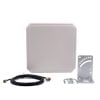
- Warehouse intake/outbound: Automated check-in of ISO containers against BOLs using gate-mounted UHF RFID readers like the HY-RU6508.
- Seal integrity verification: Pairing RFID tags with tamper-evident seals for regulatory compliance (e.g., customs, pharma cold chain).
- Multi-container consolidation: Simultaneous reading of dozens of tagged containers during stacking or loading—impossible with GPS’s one-by-one device registration.
When GPS Adds Strategic Value
GPS shines where continuous geolocation matters beyond facility boundaries:
- Ocean freight visibility: Monitoring container position mid-voyage, especially when paired with inertial sensors for port arrival/departure estimation.
- Over-the-road drayage: Real-time ETA forecasting for last-mile handoffs using GPS + cellular telemetry.
- Fleet-level optimization: Aggregating GPS traces across hundreds of containers to model route efficiency, fuel consumption, and carrier performance.
Hybrid Deployments: The Emerging Best Practice
Leading logistics providers increasingly deploy layered systems: passive UHF RFID tags (e.g., RFID inlay stickers) for precise, zero-power identification at all touchpoints—and GPS-enabled trackers for long-haul transit visibility. This approach balances capital expenditure (RFID readers), operational cost (no SIM/data plans per container), and data fidelity (event + location). Integration is streamlined via middleware that normalizes EPCIS-compliant RFID events and GPS telemetry into unified dashboards.
Comparative Summary Table
| Feature | RFID Container Tracking | GPS-Based Tracking |
|---|---|---|
| Power Source | Passive (no battery required) | Battery or solar-powered |
| Indoor/Enclosed Use | Yes — works inside metal containers | No — requires satellite signal |
| Read Range | Up to 15 m (line-of-sight), scalable with reader density | Global — but location accuracy ±5–10 m |
| Data Frequency | Event-triggered (instantaneous, no latency) | Configurable (e.g., every 5 min), subject to battery life |
| Total Cost of Ownership (5-year) | Lower — one-time tag + reader investment | Higher — hardware + SIM + data plan + battery replacement |
Frequently Asked Questions
Can RFID tags be read through metal shipping containers?
Yes — specially engineered anti-metal RFID tags use ferrite-backed inlays and tuned antenna designs to function reliably on or inside metal surfaces, including ISO container walls and chassis.
Do I need separate RFID chips for each container?
Each container requires a uniquely encoded RFID tag—not just a generic chip. RFIDHY offers pre-encoded UHF RFID tags with EPC Gen2v2 compliance and configurable TID/EPC memory, ensuring global uniqueness and secure serialization.
Is RFID container tracking compatible with existing WMS platforms?
Yes. Our RFID readers output standardized ASCII or XML event streams compliant with EPCIS 2.0. Integration with major WMS vendors (Manhattan, Blue Yonder, Oracle) is supported via documented REST APIs and middleware connectors available through RFIDHY.
Optimize Your Container Visibility Strategy
Whether you’re modernizing a single port terminal or scaling RFID container tracking across a global logistics network, RFIDHY delivers purpose-built hardware, engineering support, and application expertise. Explore our industrial RFID tag portfolio—including laundry-rated tags for reusable container assets—and schedule a no-cost technical consultation with our supply chain specialists today.
Leave your contact detail now to get the latest price!